
The Morgan Stanley Email Leak: When the Security Threat Is “Send”
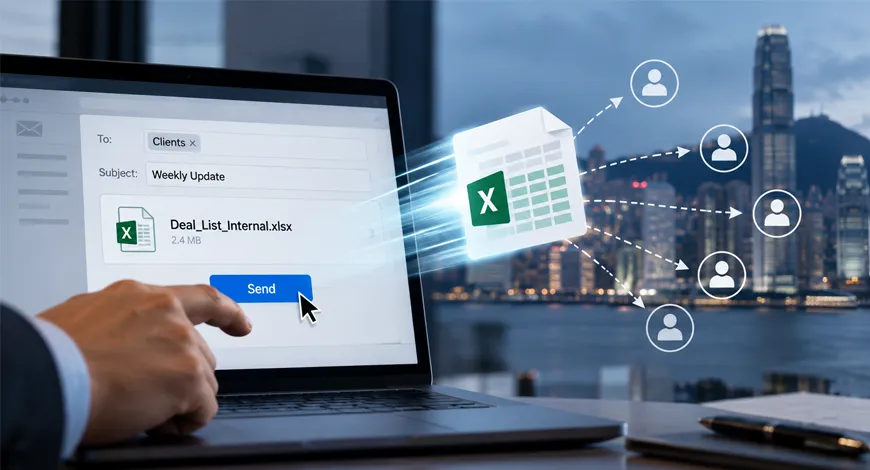

A Morgan Stanley incident shows how information can leak without a single bad actor.
Sometimes it’s just a stray attachment and a click.
Such was the case at Morgan Stanley’s Hong Kong office in September 2026. A Morgan Stanley employee meant to attach a client-facing version of a deal list in his weekly client update. Instead, he attached the internal version, which contained information on more than 100 deals Morgan Stanley was pitching or monitoring.
The employee tried to retract the email, and he subsequently asked recipients not to open or distribute the attachment. But it was too late. According to the South China Morning Post, the deal list had already circulated widely within the financial sector. A blurred copy even appeared on Instagram.
Morgan Stanley has been meeting with clients and contacting affected parties. Regulators have also begun looking into the incident, and the bank has reportedly required employees to undergo compliance training.
Here’s what makes the incident so compelling: access control worked. Authentication worked. The email system worked. The authorized senior employee was doing his job. And confidential information still walked out the door.
The incident suggests several lessons.
1. Cybersecurity goes deeper than just keeping attackers out.
Inbound email security is designed to stop incoming threats. This was information going out.
The distinction matters. Traditional security asks, Should this person have access to this information?
But another question is becoming more salient: Should this information be leaving the organization?
2. Authorized doesn’t mean appropriate.
The employee had legitimate access to the deal pipeline. He also had legitimate authority to email clients. Put the two together, however, and you have a potentially serious disclosure.
That is the weakness of relying too much on access control. Identity and permissions can establish who’s allowed to see a document, but they don’t prevent that person from sending it where it shouldn’t go.
3. The attachment deserves as much scrutiny as the email.
Outbound email controls tend to focus on recipients, destinations and obviously sensitive data. But the attachment may be the most sensitive part of the message. In this case, a routine client update became a potentially serious threat to the brand and the business.
Security systems need to recognize sensitive documents before they leave the organization.
4. Sensitive information should create friction.
Security teams generally try to make controls invisible. But some actions shouldn’t be easy to perform accidentally. A document crammed with confidential information should trigger a warning, require confirmation or approval, or simply be blocked from external email.
That isn’t getting in the user’s way. It’s putting the obstacle where it belongs.
5. DLP has to understand context.
Data-loss prevention is generally good at spotting things that look sensitive. But a deal sheet is different. Sensitive business information doesn’t always announce itself through predictable markers like credit-card or national ID numbers. That’s why a checkpoint that makes the sender look at the attachment itself, not just scan it for patterns, matters so much.
6. Human error is part of the threat model.
Internal training can always improve corporate security. But the ultimate answer is not another reminder to “be careful.” People attach the wrong file, select the wrong recipient and hit Send before they realize what they’ve done.
Recall may limit the damage, but it happens after the information has already left the organization. Once sensitive information reaches an external inbox, control of it is effectively gone, as the Morgan Stanley incident makes all too clear.
Security has to assume people will make mistakes.
7. Information risk is business risk.
The Morgan Stanley leak has not, at least so far, resulted in publicly reported major financial losses. A significant number of the transactions were already public, according to reporting.
But confidentiality matters for reasons that go well beyond IT. The leak exposed client relationships and the status of potential transactions. It also attracted regulatory scrutiny and put the bank in the uncomfortable position of explaining the mistake to its clients.
That’s the larger point. A security incident doesn’t have to bring down a network to put the business at risk. Sometimes everything works exactly as intended right up to the moment somebody clicks Send.
What an extra checkpoint before Send can change
Consider the moment this incident reportedly occurred. An employee is sending a routine update to external clients, but the wrong file is attached.
With VIPRE SafeSend in place, the sender can be prompted to verify that the message is going outside the organization and review the recipients and attachments before the email is released. Seeing the attachment clearly presented for confirmation creates one more opportunity to recognize that the wrong file has been selected.
VIPRE SafeSend is designed to put an additional safeguard at the point where a simple mistake can become a data-loss incident: before the employee clicks Send.
Could this happen in your organization?
Give your employees one more chance to catch a costly email mistake before it’s sent.
See how VIPRE SafeSend protects the point of send →
VIPRE SafeSend: Stop Email Mistakes Before They Leave
Give employees a critical final checkpoint to verify recipients and attachments before they hit Send.